Salt, moisture, and heat: how a KES 4,500 ESP32 thermal camera can find building defects before they become structural problems
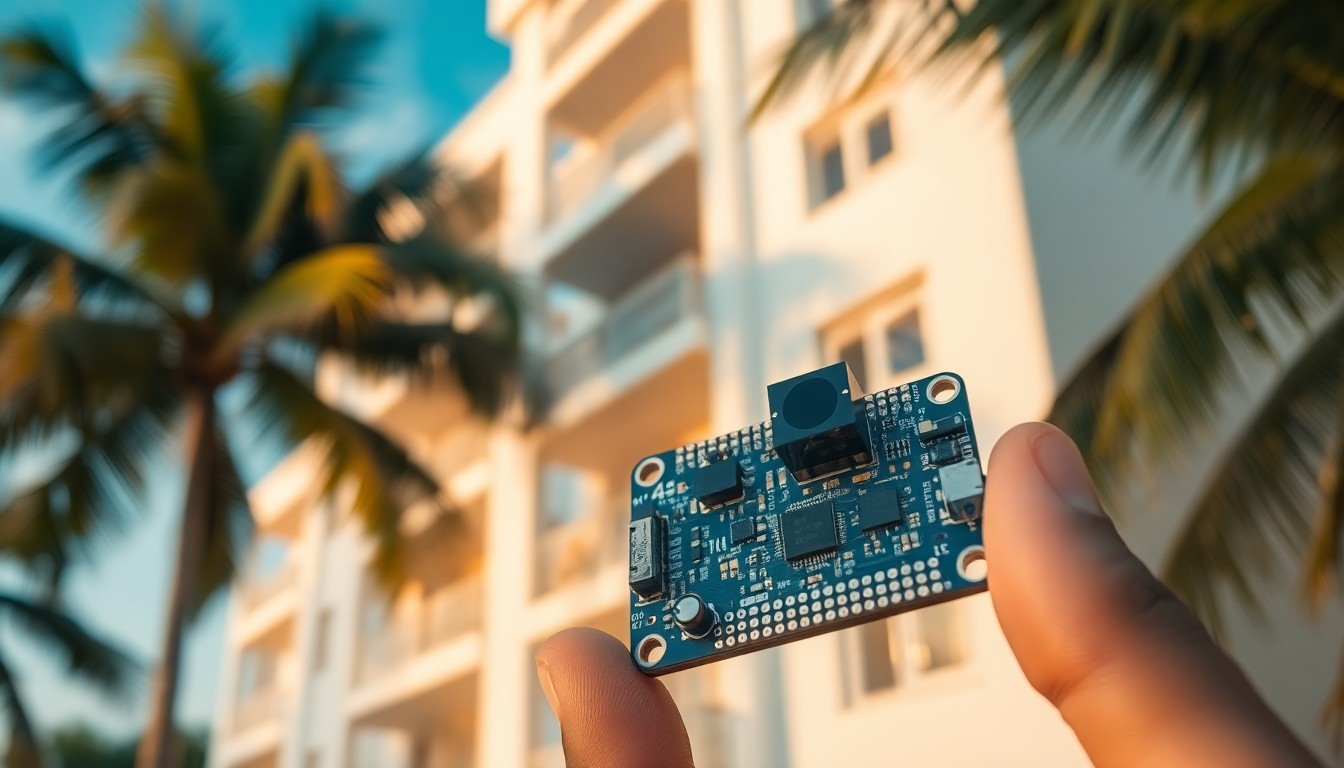
Coastal buildings in Mombasa, Diani, and Malindi deteriorate faster than inland buildings. Salt spray corrodes reinforcement. Monsoon moisture penetrates poorly sealed facades. Thermal bridging in uninsulated roofs drives up cooling costs and damages finishes. A thermal camera connected to an ESP32 microcontroller with edge AI — total hardware cost under KES 4,500 — can detect moisture ingress, failing AC units, electrical hotspots, and envelope leaks before they become expensive repairs. This article explains how embedded vision systems running on commodity hardware are bringing preventive building inspection within reach of every coastal property owner.
Why coastal buildings in Mombasa deteriorate faster — and why you often cannot see it happening
A building on Mombasa Island, Nyali, or the Diani beach strip ages differently from a building in Nairobi. The difference is the marine environment. Salt-laden air — carried inland by the southeast monsoon from April to October — deposits chlorides on exposed concrete surfaces. These chlorides penetrate through micro-cracks in the concrete cover and reach the reinforcing steel. Once chlorides reach the steel at sufficient concentration, corrosion begins. The steel expands as it rusts, cracking the concrete from the inside. The first visible sign — a rust stain or a hairline crack — appears months or years after the corrosion started.
At the same time, the coastal climate imposes two moisture regimes. During the long rains, driving rain saturates external walls that have not been properly sealed. During the dry season, high humidity keeps internal spaces damp. Moisture trapped in wall cavities and roof spaces supports mould growth, degrades finishes, and accelerates the corrosion of metal fixings and fasteners.
The third mechanism is thermal. Coastal buildings — particularly older apartment blocks and villas with uninsulated concrete roofs — absorb solar radiation during the day and radiate heat into the interior at night. The thermal expansion and contraction cycle stresses materials, opens joints, and creates pathways for moisture ingress. The occupants feel it as a hot room and a high air-conditioning bill. The building feels it as cumulative structural stress.
The problem with all three mechanisms is that they are invisible until they are expensive. By the time a rust stain appears on the wall, the rebar behind it has already lost cross-section. By the time a damp patch appears on the ceiling, the roof membrane has been leaking for months. Thermal cameras — sensors that see temperature differences rather than visible light — can detect these problems before they become visible.
What a thermal camera sees that your eyes miss — and an ESP32 can now run it
A thermal camera captures infrared radiation — heat — rather than visible light. It produces an image where each pixel represents a temperature rather than a colour. On a building, a thermal image reveals patterns that are invisible to the naked eye.
Moisture in a wall or ceiling evaporates more slowly than the surrounding dry material, creating a cool spot that the thermal camera sees as a temperature anomaly. An electrical connection that is loose or overloaded generates heat — a hotspot that the thermal camera sees long before a fuse blows or a fire starts. A gap in wall insulation or a failed window seal shows as a thermal bridge — a line or patch where heat is transferring faster than through the surrounding structure. An AC unit with a blocked condenser coil runs hotter than it should — the thermal camera sees the elevated temperature before the unit fails.
Until recently, thermal cameras were expensive professional instruments costing upwards of KES 50,000. The AMG8833 thermal sensor — an 8x8 pixel infrared array — changed that. It costs approximately KES 2,500 and connects directly to an ESP32 microcontroller. Combined with an ESP32-CAM module for a visible-light reference image, the total hardware cost is under KES 4,500.
The resolution is low — 64 pixels cannot produce a detailed thermal image. But 64 pixels are sufficient to detect temperature anomalies at the scale of a wall section, a ceiling panel, an electrical panel, or an AC condenser. A machine learning model running on the ESP32 compares the thermal pattern against a baseline and flags anomalies — no human needs to interpret the thermal data, and no cloud processing is required.
How edge AI on an ESP32 makes thermal inspection automatic — no thermal imaging expertise required
The traditional thermal inspection workflow requires a trained thermographer: someone who understands emissivity, reflected temperature, and thermal patterns specific to building materials. The thermographer takes thermal images, interprets them, and writes a report. This is a specialised professional service — valuable, but not affordable or practical for routine building monitoring.
Edge AI changes the workflow from skilled interpretation to automated anomaly detection. The ESP32 runs a TinyML model that has been trained on baseline thermal patterns for the specific building — the normal temperature distribution across a south-facing wall at 2 pm in August, the normal temperature of the main electrical panel under load, the normal cooling pattern of the AC condenser during operation.
The device captures thermal readings on a schedule — daily, weekly, or monthly. The TinyML model compares each reading against the baseline. If the reading is within normal variation, nothing happens. If the reading deviates — a persistent cool spot on a wall that was previously uniform, indicating moisture ingress; a hotspot on an electrical connection that was previously ambient, indicating a failing contact — the device flags an alert.
No thermal imaging expertise is required to operate the system, because the system does not produce images for human interpretation — it produces alerts based on deviation from baseline. The building owner or maintenance manager receives a notification: 'South wall, third floor, moisture anomaly detected — recommend inspection'. The thermal expertise is embedded in the model, not in the operator.
What this costs — and what it prevents
The hardware: an ESP32 development board (KES 800), an AMG8833 thermal sensor (KES 2,500), and a small solar panel or battery pack (KES 1,200). Total hardware: approximately KES 4,500 per monitoring point. A typical apartment building might deploy three to five monitoring points — one for the electrical room, one for the roof, and one for each exposed facade. Total system cost for the building: KES 15,000-25,000.
The software: Edge Impulse or TensorFlow Lite Micro for the TinyML model. Both are free and open-source. The model training requires a laptop and a few weeks of baseline thermal readings to establish normal patterns. A university engineering student or a local electronics technician can set up and calibrate the system.
What this prevents: a single undetected moisture ingress event that leads to rebar corrosion and concrete spalling can cost KES 100,000-500,000 to repair on a coastal building, depending on the extent and location of the damage. A single electrical fire in a distribution panel — the most common cause of building fires in Mombasa — can cost lives and millions in damage. A single AC condenser failure during the hot season costs KES 30,000-80,000 to replace and weeks of discomfort for occupants.
The economics are straightforward: the hardware costs less than one unplanned repair. The system pays for itself the first time it catches a problem before it becomes a failure.
From Dubai to Diani: preventive building inspection is already happening — the hardware just got cheap enough for Kenya
Preventive thermal inspection of buildings is standard practice in markets where construction quality risk is priced into insurance and maintenance contracts. Dubai mandates thermal inspection of building envelopes as part of its green building regulations. Singapore requires periodic thermal scanning of electrical installations in commercial buildings. Facilities management contracts in Europe and North America increasingly include thermal monitoring as a standard scope item.
These markets use professional-grade thermal cameras costing $5,000-20,000 and trained thermographers charging professional rates. The same quality of anomaly detection — not the same image resolution, but the same ability to detect moisture, thermal bridging, and electrical hotspots — is now available on hardware costing under $50.
The application to Kenya's coastal buildings is direct and specific. A hotel in Diani that wants to reduce maintenance costs and avoid guest complaints about damp rooms. An apartment block in Nyali where the owners' corporation wants to catch envelope defects before they become special levy items. A commercial building on Moi Avenue where the facilities manager wants to prevent electrical failures that close the building for days.
REDM's construction management and MEP engineering services cover the professional side — specification review, installation inspection, snagging, and handover inspection. The edge AI thermal monitoring layer extends this coverage into the operational life of the building — the years after handover when maintenance decisions determine whether the building lasts 20 years or 50.
Next step
Turn this insight into a project decision
Use the free check or calculator while the question is still fresh. If the numbers make sense, continue into report delivery, capture and project setup.
Get a project checkFrequently asked questions
Can a KES 2,500 thermal sensor really find building defects?
Yes — not with the image quality of a professional thermal camera, but with sufficient resolution to detect temperature anomalies at the scale of a wall section, electrical panel, or AC unit. The AMG8833's 64 pixels detect temperature differences as small as 2.5 degrees Celsius, which is sensitive enough to identify moisture ingress, thermal bridging, and electrical hotspots. The edge AI model compares readings against baseline patterns to distinguish genuine anomalies from normal temperature variation.
Do I need a thermal imaging expert to operate this?
No. The edge AI model handles the interpretation. The system is trained on baseline thermal patterns for the specific building and automatically flags deviations. The operator receives an alert with the location and nature of the anomaly. Professional thermal imaging expertise is still required for detailed diagnostic surveys, but not for routine monitoring.
How long does the system take to set up and calibrate?
Hardware assembly takes approximately one hour per monitoring point. Baseline data collection takes two to four weeks of normal building operation to establish normal thermal patterns. Model training takes a few hours on a laptop. Total time from hardware purchase to operational monitoring is approximately four to six weeks.
Can this system work on older coastal buildings without modern construction standards?
Yes — in fact, older buildings benefit more because they have accumulated more defects. The system's anomaly detection works by comparing current readings against the building's own baseline, regardless of construction standard. A 30-year-old apartment block in Mombasa Old Town can be monitored with the same hardware as a new development in Nyali.