The construction stage in Kenya: what happens between groundbreaking and handover
Construction is the most capital-intensive stage of any development project, and the one where most financial control is lost. Understanding the sequence from contractor appointment to practical completion — and the professional oversight required at each step — is what separates a controlled project from an expensive one.
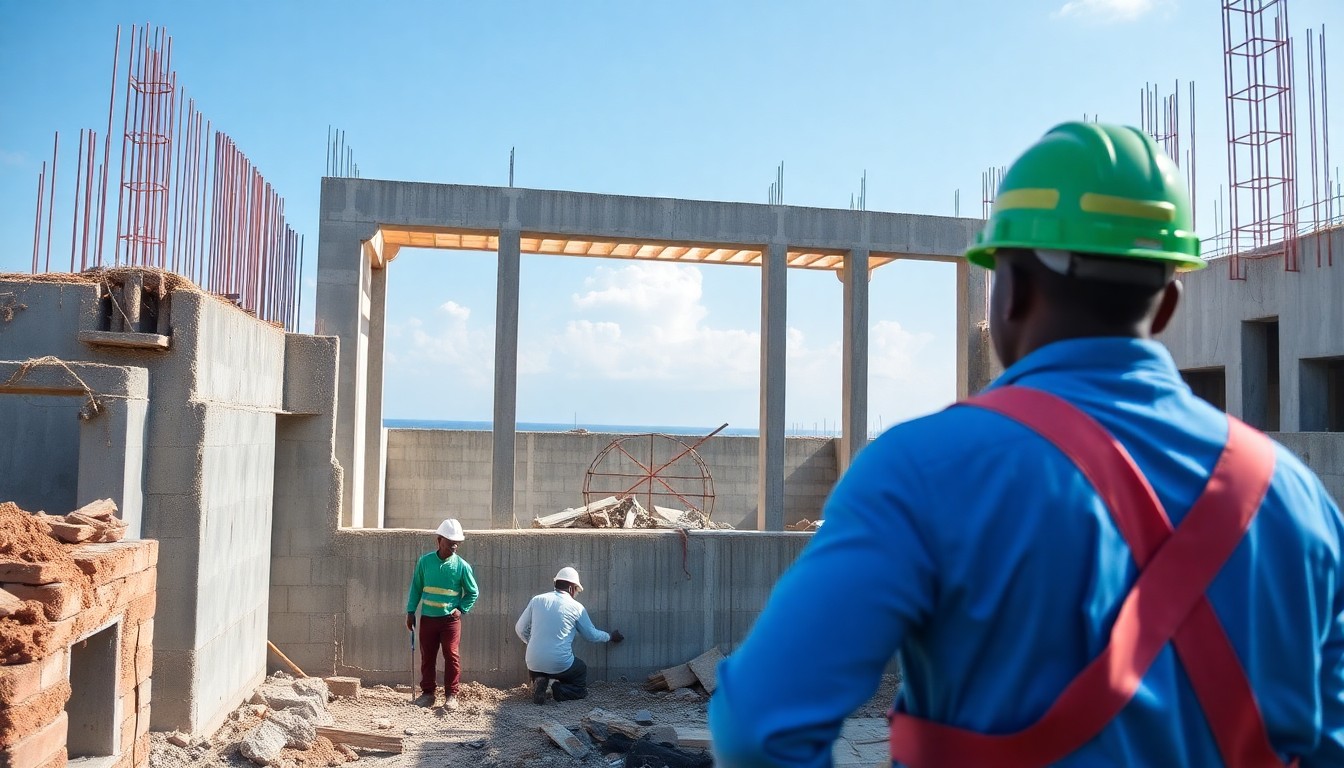
The construction stage in the project lifecycle
The construction stage begins when a contractor is appointed, a contract is signed, and the site is handed over for mobilisation. It ends at practical completion — the point at which the building is substantially complete, ready for occupation, and formally certified as such by the architect.
Between those two points is a sequence of physical and administrative events that — managed well — produce a building on time, on budget, and to specification. Managed poorly, they produce a building that costs 20–40% more than anticipated, takes twice as long, and has defects that emerge within two years.
The construction stage is not primarily a management challenge — it is an information and oversight challenge. The contractor performs the work. The question is whether the client's professional team has the information (drawings, specification, BoQ) to instruct the contractor precisely, and the oversight (quantity surveying, construction management, contract administration) to verify that work is being done correctly.
This guide covers each phase of the construction stage in sequence, the professional roles that operate at each phase, and what good oversight looks like in practice. For an overview of the oversight roles — QS, PM, CM, and architect CA — and what they cost, see the professional fees guide at `/insights/professional-fees-architects-qs-engineers-kenya`.
Phase 1: Contractor appointment and contract
Contractor selection in Kenya should be conducted through a formal tender process using a priced bill of quantities. Three to five contractors are invited to price the BoQ. The QS evaluates the returned tenders, checks for arithmetic errors, queries unusually low or high rates, and prepares a tender comparison report recommending the preferred contractor.
The lowest tender is not automatically the right choice. A contractor who has priced significantly below the others may have misunderstood the scope, used unrealistic rates that they will seek to recover through variations, or have a weak financial position that creates completion risk. The QS's evaluation weighs price, programme, references, and financial standing.
The contract should be a formal written document. In Kenya, the Joint Building and Civil Engineering Committee (JBCC) suite of contracts is commonly used for building projects, alongside JCT-based forms and NEC contracts for larger or infrastructure projects. At minimum, the contract should cover: scope of work by reference to the drawings, specification and BoQ; contract sum; commencement and completion dates; extension of time provisions; liquidated damages for delay; payment mechanism (monthly valuations or milestone payments); and retention provisions.
Do not begin construction without a signed contract. A verbal appointment or letter of intent without a contract provides almost no protection for the client when disputes arise — and disputes arise on most projects.
Phase 2: Mobilisation and substructure
Mobilisation covers the period from contract signing to the commencement of physical works. The contractor establishes the site compound, installs temporary water and power, sets up site security, and completes any required NCA notifications for projects above KES 5M.
Setting out is the first construction activity: the surveyor transfers the building position from the drawings to the ground, establishing the gridlines and datums from which all subsequent construction dimensions are taken. An error in setting out is a fundamental error — it affects every subsequent measurement. The construction manager or architect should verify setting out before any excavation begins.
Substructure covers all works below the finished floor level: bulk excavation, pile installation or foundation construction, ground beams, and ground slab. Foundation type is determined by the structural engineer based on the soil investigation report. In Mombasa's coastal geology — which includes coral rock, sand, and varying water table levels — foundation design requires specific engineering judgement and cannot be assumed from standard practice elsewhere.
The structural engineer should be on site, or review the works closely, during foundation construction. Foundation quality cannot be inspected after it is covered. Incorrect reinforcement or inadequate concrete cover in a foundation in a coastal environment will cause corrosion-related structural damage within 10–15 years.
Phase 3: Superstructure and envelope
The superstructure is the above-ground structural frame: columns, beams, slabs, and staircase cores. For reinforced concrete construction — which is standard in Kenya — this phase involves repeated cycles of: form the formwork, fix the reinforcement, pour the concrete, cure, and strip. The QS takes interim valuations at agreed intervals (typically monthly), comparing measured work against the priced BoQ.
The structural engineer inspects the reinforcement at key stages before the concrete pour — this is the inspection hold point where inadequate reinforcement can be corrected. Once concrete is poured, it cannot be undone. The construction manager should coordinate the inspection programme so the engineer's visit coincides with reinforcement readiness, not after the pour.
Masonry works — blockwork walls, both external and internal — proceed alongside or immediately after each floor's structural completion. The envelope (external walls, windows, and roof) follows. On coastal sites in Mombasa, external wall specification is critical: the marine environment accelerates corrosion of embedded metalwork and degradation of cement-based renders. Specification of appropriate finishes is an architect decision, not a contractor one.
Concrete cube tests should be taken at every major pour — one set per 50m³ or per day of pouring, whichever produces more samples. The construction manager collects, labels, and dispatches samples. Test results must be reviewed by the structural engineer. Failing cube tests require immediate investigation — not the option to 'see if the structure performs.'
Phase 4: MEP installation and finishes
MEP installation — the mechanical, electrical, and plumbing systems — begins once the structural frame is sufficiently complete for the MEP sub-contractors to work within it. MEP installation proceeds in a sequence: first fix (concealed pipework and conduit installed before plastering); second fix (equipment, outlets, and fittings installed after plastering and painting); and commissioning (systems tested and set to work).
First fix MEP is the phase where coordination failures become expensive. If the drainage pipe runs conflict with the ceiling void heights, or the electrical conduit runs conflict with the block wall positions, the MEP engineer and architect must issue revised drawings. In a coordinated design this is resolved at design stage. In an uncoordinated design it is resolved on site, at cost.
Finishes cover the internal completion works: plastering, screed, tiling, timber flooring, ceiling systems, painting, joinery, and sanitary ware installation. The specification of finishes — set out in the architectural finishes schedule — is the primary determinant of the building's perceived quality at handover. Changes to finishes specification during construction are among the most common sources of variation claims.
The QS values finishes work against the BoQ rates. Where the contractor claims for additional works not in the BoQ, the QS and architect review the instruction that authorised the work. Any instruction to vary the works must be issued in writing by the architect — verbal instructions carry no contractual weight.
Phase 5: Snagging, practical completion, and the defects period
Snagging is the process of systematically inspecting the completed works against the specification and producing a list of defects to be rectified before practical completion is certified. It is carried out jointly by the construction manager and the architect. A thorough snag list on a mid-scale building will typically contain 100–500 items, ranging from minor paint defects to unacceptable tile alignment to faulty electrical outlets.
Practical completion is certified by the architect when the building is substantially complete — meaning all works required under the contract have been carried out to a standard such that the building can be occupied, and any remaining defects are minor enough not to prevent use. The certificate of practical completion triggers two things: release of half the retention money (typically 2.5% of contract sum), and commencement of the defects liability period.
The defects liability period in Kenya is typically 6–12 months, specified in the contract. During this period the contractor is obliged to return to site and rectify any defects that emerge in normal use, at no additional cost. The QS and construction manager manage the defects liability list. At the end of the period, the architect issues the final certificate and the balance of retention is released.
The final account — the agreed final financial settlement between client and contractor — is prepared by the QS. It takes the contract sum, adds agreed variations (priced against BoQ rates), deducts any liquidated damages for delay, and arrives at the final sum due. A well-managed final account on a KES 50M project may take 1–3 months to agree. A poorly managed one — with no BoQ, no variation records, and disputed instructions — may take years.
If you are planning a construction project and want to understand what professional oversight your project requires from contractor appointment through to handover, use the project check at `/feasibility/wizard`.
Istisna: Islamic construction contract milestones
For Muslim developers, the contractor appointment can be structured as Istisna — a commission to build for an agreed price with milestone-linked payments. Istisna does not replace Kenyan construction law or standard contract forms (JBC, FIDIC), but it frames the economic relationship without interest on late payment: fixed contract sum, agreed variations procedure, milestones tied to completion (foundation, slab, roof, finishes, practical completion), and charity penalty clauses instead of compounding interest.
The contractor's BoQ, programme, and retention terms remain — Istisna sits as the Shariah-compliant payment structure on top. Key milestones map directly to the construction programme you already manage: mobilisation (10 percent), foundation (15 percent), structure (25 percent), finishes (25 percent), practical completion (20 percent), retention release after defects (5 percent). Read the Istisna construction contracts article for the full checklist and halal audit points before appointing a contractor.
Next step
Turn this insight into a project decision
Use the free check or calculator while the question is still fresh. If the numbers make sense, continue into report delivery, capture and project setup.
Check your project scope and feesFrequently asked questions
How long does construction take in Kenya for a typical apartment block?
A mid-scale residential apartment block of 8–16 units in Kenya typically takes 14–22 months from contractor mobilisation to practical completion, depending on the number of storeys, specification level, contractor capacity, and site conditions. Ground-plus-three is typical for Mombasa residential developments and runs to 16–18 months under normal conditions. A realistic programme should allow contingency for weather (heavy rains affect concrete curing and masonry) and material supply lead times.
What is retention in a construction contract?
Retention is a percentage of the contract sum (typically 5%) that is withheld from each payment certificate and held as security for the contractor's performance. Half (2.5%) is released at practical completion. The balance is released at the end of the defects liability period, when the architect issues the final certificate. Retention aligns the contractor's financial interest with completing the work and returning to fix defects.
What are liquidated damages in a construction contract?
Liquidated damages (LDs) are a pre-agreed daily or weekly sum that the contractor pays the client for each day the project is completed beyond the contract completion date. In Kenya, LDs are typically set at 0.1–0.5% of the contract sum per week of delay. LDs are deducted from the final account, not imposed as a penalty after the fact. They must be set at a genuine pre-estimate of the client's loss from delay — not a punitive figure.
What happens if the contractor abandons the site in Kenya?
Contractor abandonment — where the contractor stops work and leaves site without completing the contract — is handled under the contract's termination provisions. The architect issues a notice, a period elapses, and if the contractor does not return, the contract is terminated. The client can engage a new contractor to complete the works and claim the additional cost against the original contractor (or their bond, where one exists). This is an expensive and slow remedy. Prevention — through proper contractor selection and retention of NCA-registered, financially stable contractors — is strongly preferable.
What is the NCA levy and when is it payable?
The National Construction Authority (NCA) levies a statutory fee of 0.5% of the contract sum, payable by the contractor for projects above KES 5M. The NCA levy is paid during contractor registration for the project. Projects without an NCA levy payment are technically in non-compliance with NCA regulations, which can affect the issuance of an occupancy certificate.