BIM in Kenya: what Building Information Modelling means for your project
BIM is increasingly referenced in Kenyan construction procurement but rarely understood by clients. It is not a software package and it is not just a 3D model. This guide explains what BIM delivers, when it is required, what it costs as an uplift on design fees, and how it changes the way a building is designed and built.
What BIM actually is
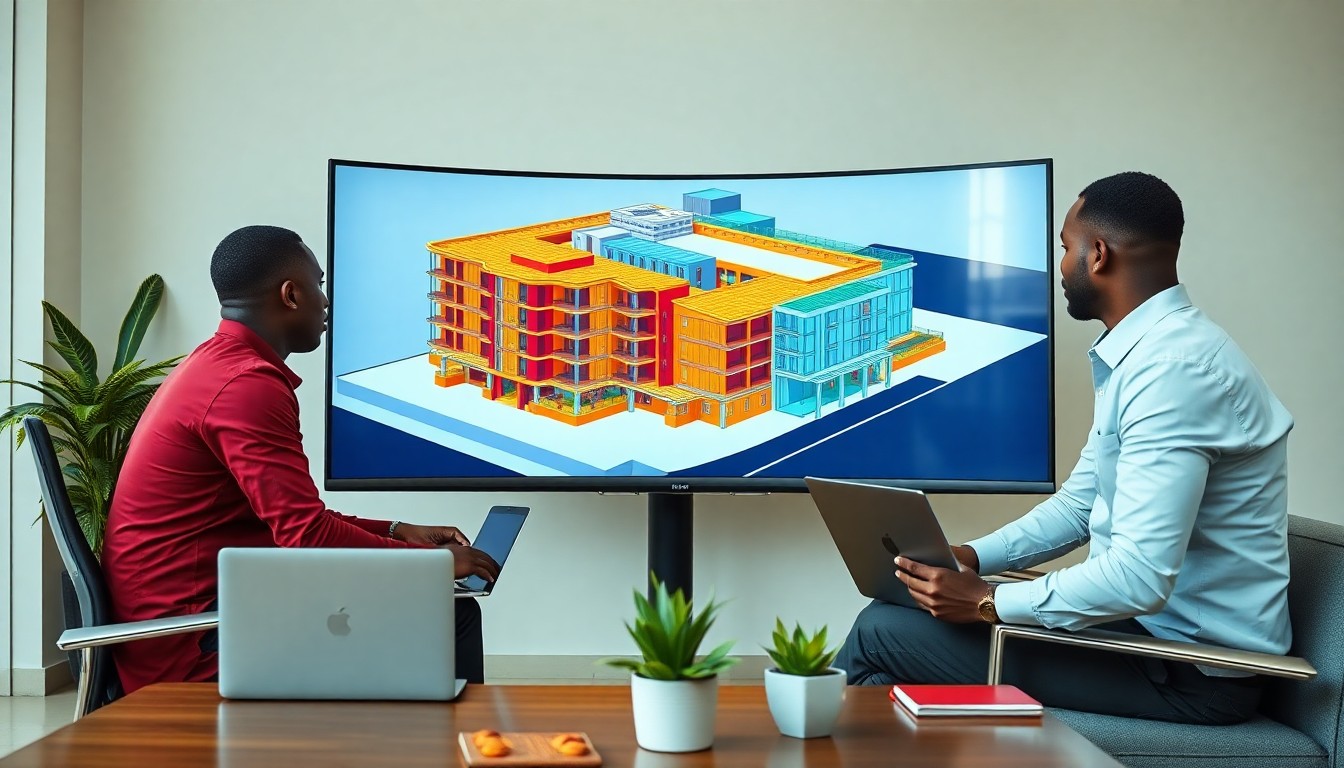
Building Information Modelling (BIM) is a process for creating and managing information about a built asset throughout its lifecycle — from design through construction to operation. The central product of BIM is a digital model that contains not just geometry (3D shapes) but information: the type of material a wall is made from, the manufacturer and specification of a door, the maintenance schedule for a piece of plant, the as-built dimensions of every structural element.
BIM is frequently described as if it is a 3D drawing or a visualisation tool. It is neither. A 3D model is a geometric representation. A BIM model is an information system. The geometry is a container for data, not the point.
In practical terms, BIM changes how a design team works together. Instead of each discipline (architect, structural engineer, MEP engineer) working on separate 2D drawings that are coordinated by exchanging PDFs and holding drawing coordination meetings, BIM puts all disciplines into a single federated 3D model. Clashes between a structural beam and an HVAC duct are detected automatically in the model, before anyone is on site. Wall types carry their thermal performance data, enabling energy modelling. Structural sections carry their load specifications, enabling automated structural analysis.
The result, on projects where BIM is implemented correctly, is fewer design errors, faster coordination, reduced construction programme risk, and a better-quality handover package for the building operator.
BIM in Kenya: the regulatory context
The National Construction Authority (NCA) has been progressively introducing BIM requirements for projects above certain thresholds. BIM is currently required or strongly expected for NCA-registered projects at Grade 5 and above — typically projects above KES 500M and for government procurement above certain values.
Below that threshold, BIM is not a statutory requirement in Kenya. However, international developers, development finance institutions (DFIs), and sophisticated private clients are increasingly including BIM requirements in their briefs, regardless of NCA thresholds. A developer seeking financing from a DFI for a large mixed-use project will typically encounter BIM requirements in the lender's technical due diligence checklist.
The practical position for most private development projects in Kenya — residential and small commercial — is that BIM is not required but can be adopted where it adds value. For projects in the KES 50M–200M range, the BIM uplift cost is manageable and the coordination benefits are real.
For projects below KES 30M on straightforward building types, BIM adds cost and process complexity that may not be justified by the coordination benefits. The design team's recommendation on whether BIM is appropriate for a specific project should be sought at briefing stage.
What BIM delivers: the four key outputs
Clash detection is the most immediately quantifiable benefit of BIM. In a federated model combining architectural, structural, and MEP disciplines, the BIM manager runs clash detection reports that identify where one discipline's elements physically intersect with another's. A structural downstand beam that runs through an HVAC duct. A drainage pipe that passes through a structural column. A light fitting position that conflicts with a structural tie rod. These clashes, detected in the model before construction begins, are resolved by a design instruction — not a site variation claim. On a project of modest complexity, clash detection can identify 50–200 design errors before construction begins.
4D scheduling adds the construction programme as a fourth dimension to the 3D model. Each element in the model is linked to a schedule activity, enabling the construction sequence to be simulated visually. This is used to identify sequencing constraints (a crane cannot access a location on a given date because a temporary works structure is still in place), communicate the programme to subcontractors, and track progress against the programme during construction.
The as-built model is the most enduring deliverable. Where a traditional project produces a set of as-built drawings that are filed and often lost, a BIM project produces a digital model of the building as actually built — with accurate geometry and embedded information about every component. This model is the starting point for facility management, maintenance planning, and any future renovation or extension.
COBie (Construction Operations Building Information Exchange) is the data format used to transfer the building's asset information from the design and construction team to the facilities management team at handover. It is a structured spreadsheet containing information about every maintainable component in the building: its type, location, manufacturer, model, installation date, warranty period, and maintenance requirements. For commercial and hotel buildings, COBie data is increasingly required by FM teams and insurers.
BIM management fees in Kenya
BIM management fees are structured either as a percentage uplift on design fees or as a lump sum for smaller projects. The standard uplift is 15–20% on the combined design fees (architecture + structural + MEP). For a project with combined design fees of KES 3M, a 17.5% BIM uplift is KES 525,000 — covering the BIM management service across the full design and construction period.
For smaller projects where the design fees are modest, a lump sum is more appropriate. Typical lump sum fees for BIM management on a small project range from KES 150,000–400,000.
What the BIM management fee covers: setting up the Common Data Environment (CDE) — the shared digital workspace where all disciplines access and update the federated model; coordinating model submissions from each discipline; running clash detection reports at agreed intervals; managing the BIM Execution Plan (BEP) compliance; and producing the as-built model and COBie data at handover.
The BIM manager may be a specialist individual or a firm. On larger projects, the BIM manager is a standalone appointment. On smaller projects, one of the design team members (typically the architect) may carry the BIM management responsibility within their appointment, with the uplift applied to the architectural fee.
BIM and the REDM platform
The REDM platform uses BIM-like data structures in its project model. Every project in the system references a parcel, a set of design parameters, a professional team, and a programme — the same information architecture that BIM manages at the building level, REDM manages at the project lifecycle level.
For clients using REDM for project management, the transition to a BIM-enabled design process is straightforward: the project brief, programme, and professional team appointments are already in the system, and the BIM model is the technical execution of the design information that the REDM project record references.
For projects where BIM is appropriate, the professional team appointment process through REDM includes BIM management in the scope discussion. Use the project check at `/feasibility/wizard` to start this discussion for your project.
For an overview of how REDM uses technology to manage the project lifecycle, see the guide at `/insights/how-redm-turns-a-plot-check-into-a-project-file`.
Next step
Turn this insight into a project decision
Use the free check or calculator while the question is still fresh. If the numbers make sense, continue into report delivery, capture and project setup.
Discuss BIM requirements for your projectFrequently asked questions
Is BIM required for construction projects in Kenya?
BIM is currently required or strongly expected for NCA Grade 5+ projects (typically above KES 500M and for government procurement above certain thresholds). For private sector projects below this threshold, BIM is not a statutory requirement but is increasingly specified by sophisticated clients, international developers, and development finance institutions. It is optional but beneficial for projects in the KES 50M–200M range.
What does BIM management cost in Kenya?
BIM management fees are either a 15–20% uplift on combined design fees, or a lump sum of KES 150,000–400,000 for smaller projects. On a project with combined design fees of KES 3M, a 17.5% uplift is KES 525,000 for the full BIM management service through design and construction.
What is the difference between a 3D model and a BIM model?
A 3D model is a geometric representation — shapes and forms in three dimensions. A BIM model is an information system — the geometry is a container for structured data about every component of the building (material type, manufacturer, specification, maintenance requirements). BIM enables clash detection, 4D scheduling, and as-built data handover because the model carries information, not just geometry.
What is clash detection and why does it matter?
Clash detection is the automated identification of physical conflicts between elements designed by different disciplines in the federated BIM model — for example, a structural beam that runs through a duct designed by the MEP engineer. Detecting and resolving these clashes in the model before construction begins avoids the variation claims, re-work, and programme delay that arise when the same conflicts are discovered on site.
What is an as-built BIM model?
An as-built BIM model is a digital record of the building as actually constructed — with accurate geometry, updated to reflect all changes made during construction, and containing information about every maintainable component. It is the handover deliverable that allows the building owner and facilities manager to plan maintenance, manage assets, and plan future alterations from accurate digital information rather than paper drawings that may or may not reflect what was actually built.