Restaurant and commercial kitchen design in Kenya
Reader separates front-of-house from kitchen services and extraction.
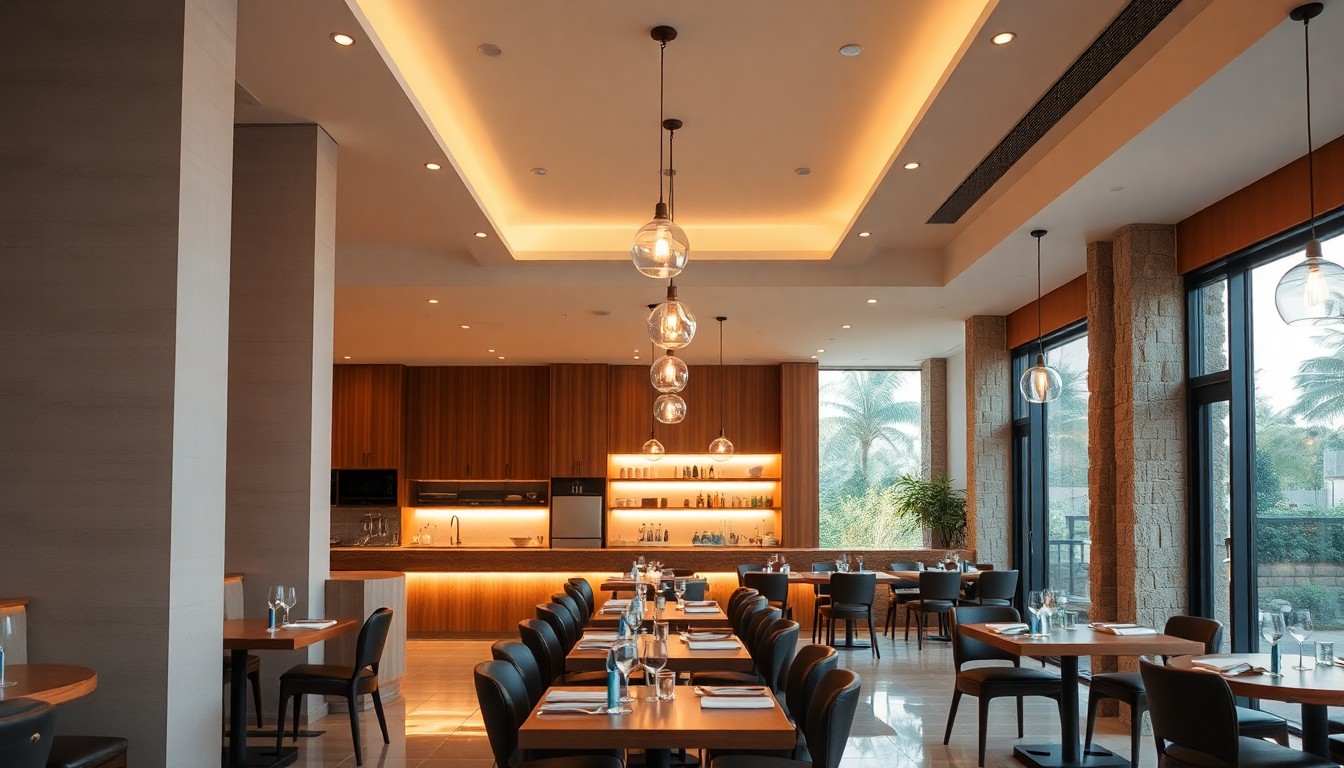
Restaurant brief starts with covers and kitchen type
Brief covers (seated meals), service style (table, buffet, fast), and kitchen category (cook-line, finishing, bakery). Neufert restaurant sections separate dining arrangements from kitchen zones and storage.
Kenyan coastal restaurants serving tourist markets may need separate staff and guest facilities beyond inland norms — brief changing rooms, prayer space, and delivery access alongside covers and kitchen category.
Neufert restaurant sections separate dining arrangements from kitchen zones and storage. The briefing sequence should follow: covers (seated meals at peak), service style (table, buffet, fast-casual), kitchen category (full cook-line, finishing kitchen, bakery only), and then MEP requirements (extraction rate, gas supply, grease management). A 60-cover fine-dining restaurant and a 200-cover buffet use the same Neufert principles but produce entirely different spatial briefs.
Front of house vs kitchen
Dining layout drives revenue; kitchen drives cost and approvals. Circulation between them must not cross customer paths with waste or gas services.
Extraction and gas interlocks are MEP-led with architect coordination — coastal humidity increases make-up air needs.
The front-of-house drives revenue; the kitchen drives cost and regulatory approvals. Circulation between them must not cross customer paths with waste removal, gas bottle movement, or delivery access. The waiter’s servery is the critical interface — Neufert shows how hot kitchen, cold kitchen, and dishwashing all feed this point. On the Kenyan coast, kitchen extraction must overcome prevailing monsoon winds: locate exhaust discharge downwind of dining terraces and guest areas.
Gas safety requires interlocked detection and shutoff systems coordinated between the MEP engineer and kitchen consultant. County fire approval for commercial kitchens in Mombasa looks specifically at extraction duct routing, fire-rated enclosure, and accessible clean-out points. Do not assume the architect handles this alone — it is a multi-discipline coordination item.
Commercial kitchen scale
Hotel kitchens, standalone restaurants, and cloud-kitchen hubs differ. Size cold rooms, prep, and wash relative to peak covers — not average lunch only.
Cloud-kitchen hubs emerging in Mombasa and Nairobi need different brief logic — delivery rider access, order staging, and separate extraction per tenant kitchen replace dining area entirely. Neufert planning principles still apply but the front-of-house vanishes.
Hotel kitchens differ from standalone restaurants, and both differ from cloud-kitchen hubs. Size cold rooms, prep areas, and dishwash capacity against peak covers, not average lunch. A restaurant serving 200 covers at dinner with two seatings needs dishwashing throughput for 400 covers in three hours — undersized dishwash is the most common kitchen bottleneck in Kenyan F&B projects.
Cloud-kitchen hubs emerging in Mombasa and Nairobi eliminate the front-of-house entirely: delivery rider access, order staging areas, and separate extraction per tenant kitchen replace dining rooms. Neufert planning logic still governs kitchen adjacencies, but the brief must now include rider waiting areas with weather protection and separate waste collection per operator.
What to do in the next two weeks
Document decisions on the REDM project file and align the team before the next fee milestone.
Schedule a kitchen consultant briefing before the architect locks the floor plan — even a half-day workshop with your intended operator and kitchen supplier prevents the most expensive layout errors. Confirm peak covers, service style, and menu category (the three inputs that drive equipment selection), then test those against the draft plan. Developers who brief covers and service style after the planning drawings are submitted typically redo MEP design at their own cost.
On the coast, confirm gas storage location with the fire department during briefing — not at submission. Mombasa County fire requirements for commercial kitchens with LPG storage differ from Nairobi and may affect site layout if cylinders need external cage with blast wall.
Briefing checklist for Kenyan developers
1. Confirm peak covers, service style (table/buffet/fast-casual), and kitchen category before layout freeze
2. Appoint architect, MEP engineer, and kitchen consultant at concept — gas interlock is multi-discipline
3. Map kitchen workflow: delivery → storage → prep → cooking → servery → dining → dishwash — no crossing paths
4. Check county fire requirements for commercial kitchen extraction and LPG storage — submit early on coast
5. Locate exhaust discharge downwind of dining terraces; size make-up air for 80-85% RH coastal ambient
6. Grease trap and cold room at accessible ground floor — not basement where coastal rains flood
7. Brief staff facilities (changing, prayer space, delivery access) alongside covers — coastal tourist market norm
8. Schedule a kitchen consultant briefing workshop before the architect freezes the floor plan
Deeper notes for board and lender packs
Confirm peak covers and kitchen type before layout freeze — a 60-cover à la carte kitchen needs different equipment and area than a 200-cover buffet. Size cold rooms, prep areas, and dishwash relative to peak, not average lunch turnover.
On the Kenyan coast, kitchen extraction must overcome monsoon humidity — specify make-up air units sized for 80–85% RH ambient conditions, not inland defaults. Grease traps need accessible ground-floor location; basement solutions flood during coastal heavy rains.
Pair this guide with the MEP engineering article for extraction and gas interlock details, and the design-stage guide for RIBA-aligned team appointments. The residential kitchen guide covers domestic units; this article addresses commercial F&B scale.
Before the next fee milestone, confirm who signs, who certifies, and who records — then hold one coordination meeting with minutes.
Next step
Turn this insight into a project decision
Use the free check or calculator while the question is still fresh. If the numbers make sense, continue into report delivery, capture and project setup.
Run a free project checkFrequently asked questions
Can dining and kitchen share a ceiling void?
Only with engineered separation and extraction — do not assume.
Who sizes kitchen equipment?
Kitchen consultant or MEP with architect layout.
Fire approval for restaurants?
County fire and NCA interfaces — coordinate early on coast.
Link to residential kitchen guide?
Residential article covers units; this covers commercial F&B.
Neufert vs operator brand standards?
Operator standards win where contracted; Neufert fills gaps in briefing.