Your construction site has no internet — a $40 Raspberry Pi can still watch it for you
Coastal construction sites in Kilifi, Kwale, and Lamu often lack reliable internet. But a Raspberry Pi Pico or Zero with LoRa radio, environmental sensors, and TinyML can monitor concrete curing, track material deliveries, log weather conditions, and alert the clerk of works — all offline, all open-source, all for under KES 5,000. This article explains how edge AI on cheap embedded hardware is closing the site monitoring gap for Kenya's remote construction projects, and what it means for developers who cannot afford delays from undetected site issues.
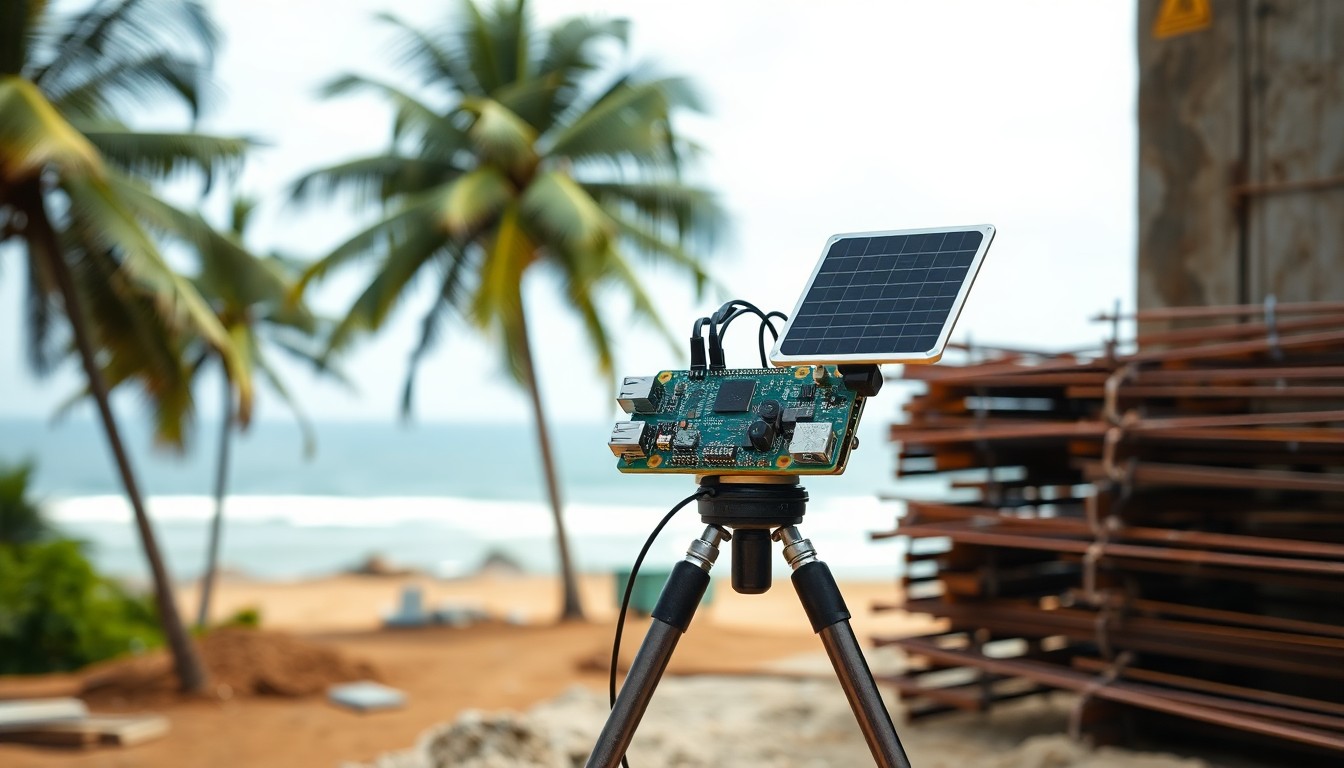
The problem: your coastal construction site has no internet — and no one is watching
Drive up the Kenyan coast past Mtwapa, through Kilifi, toward Malindi and Lamu, and you will see construction sites in various stages of progress. Concrete frames with rebar exposed to salt air. Foundation excavations filling with rainwater. Material deliveries sitting unsecured. Blockwork curing in the sun with nobody monitoring the moisture content or the ambient temperature.
These sites share a common problem: the clerk of works cannot be everywhere. On a typical coastal development, the clerk of works visits the site periodically — once a day if the site is nearby, once or twice a week if the site is remote. Between visits, concrete cures without temperature logging, materials arrive without digital recording, and environmental conditions that affect construction quality go unmonitored.
The standard solution involves connected sensors and cloud dashboards — temperature probes, humidity loggers, IP cameras, motion detectors, all streaming to a central platform. This solution assumes reliable internet. Most coastal construction sites do not have reliable internet. Kilifi's mobile coverage is patchy. Lamu's connectivity depends on the tide. Kwale's rural sites may have no data signal at all.
Edge AI changes the equation. Instead of sending sensor data to the cloud for processing, a small computer on-site — a Raspberry Pi, an ESP32, or an Arduino — processes the data locally and only sends alerts when something needs attention. No internet. No cloud subscription. No ongoing cost beyond the hardware.
What you can monitor with a KES 5,000 Raspberry Pi kit
The hardware is commodity-priced and available in Nairobi electronics shops and online. A Raspberry Pi Zero 2W costs approximately KES 2,500. A DHT22 temperature and humidity sensor costs KES 400. A dust sensor costs KES 1,000. A passive infrared motion sensor costs KES 300. A LoRa radio module for long-range, low-power data transmission costs KES 1,200. The total bill of materials is under KES 5,000.
With this hardware and free open-source software, a construction site can monitor concrete curing temperature. Concrete strength development depends on temperature — too hot and it sets too fast, increasing the risk of cracking; too cold and it sets too slowly, delaying the programme. A temperature sensor embedded in the formwork logs the curing temperature every 15 minutes and alerts the clerk of works if the temperature exceeds the specified range. No internet required.
The same device can log ambient humidity and temperature to assess the risk of salt spray corrosion on exposed reinforcement — a genuine problem on coastal sites where rebar can begin corroding within days of exposure if conditions are unfavourable. It can detect motion at night — material theft from unsecured coastal sites is a known cost. It can log rainfall — excavation flooding is a programme risk that rain data can help predict.
All data is stored locally on a microSD card. When the clerk of works visits the site, they download the log file onto their phone or laptop. No SIM card. No cloud dashboard. No monthly fee. Just a file with timestamps, readings, and alert flags.
LoRa: how you transmit data across a construction site without internet
LoRa (Long Range) is a radio technology that transmits small amounts of data over several kilometres using very little power. A LoRa module attached to a Raspberry Pi or Arduino can send sensor readings from the far end of a construction site to a receiver at the site office, or from a remote site to a receiver at the nearest town with mobile coverage.
LoRa's key advantage for coastal construction is range and power. A LoRa transmission can reach 2-5 kilometres in open terrain — enough to cover the largest construction site or to bridge the gap from a remote Lamu site to the nearest village with a cell tower. The transmitter runs on a small battery or a small solar panel — no mains power required. This is the same technology used by agricultural monitoring networks and wildlife tracking collars across Kenya.
LoRa is not fast — it transmits bytes, not megabytes. It cannot stream video or send high-resolution images. But it can send a temperature reading, a motion alert, a flood level, or a humidity log — the data points that matter for construction quality and site security. And it does so without requiring a SIM card, a data plan, or a cloud subscription.
The LoRaWAN network in Kenya is growing through community deployments and university projects. JKUAT's School of Electrical Engineering has run LoRa sensor networks for agricultural monitoring. The same technology that watches crops in Kiambu can watch concrete curing in Kilifi.
TinyML: putting an AI on a chip that costs less than lunch
TinyML — machine learning on microcontrollers — is the technology that makes edge AI on cheap hardware possible. A model trained to detect anomalies in temperature data, or to recognise the sound of a concrete mixer versus background noise, or to count vehicles entering a site gate — runs on a microcontroller that costs KES 500.
A TinyML model is trained on a laptop or in the cloud using recorded data — normal temperature patterns during concrete curing, normal noise levels during working hours, normal movement patterns at the site gate. The trained model is compressed into a file that fits on a microcontroller. Once deployed, the microcontroller compares real-time sensor data against the model and triggers an alert when the data deviates from normal.
For a construction site, this means the monitoring system learns what 'normal' looks like and only bothers the clerk of works when something is abnormal. A temperature spike during curing. A noise pattern that suggests the mixer is running outside working hours. Motion at the gate at 2 am. The microcontroller processes these decisions locally — no data leaves the site, no internet connection is used, and no cloud bill accumulates.
Edge Impulse and TensorFlow Lite Micro are the two main open-source frameworks for TinyML development. Both are free. Both have tutorials specifically for environmental monitoring and anomaly detection. The barrier to entry is a laptop, a USB cable, and a willingness to follow a tutorial.
What this means for developers and contractors on the Kenyan coast
The practical implication of edge AI construction monitoring is straightforward: you can now instrument a remote coastal site for the cost of a few site lunches. The technology is open-source, the hardware is off-the-shelf, and the skills to deploy it are taught in Kenyan university engineering programmes and maker communities.
For a developer managing multiple coastal projects — a residential block in Kilifi, a hotel extension in Watamu, a villa renovation in Lamu — the ability to receive alerts when site conditions deviate from normal, without relying on site supervisors who cannot be everywhere, changes the risk profile of remote construction. Undetected concrete curing failures. Unreported material deliveries. Unmonitored environmental conditions that accelerate corrosion. These are not theoretical risks — they are documented cost drivers on coastal projects.
REDM's clerk of works inspection service covers periodic site visits with structured reporting — what the inspector saw, what was compliant, what requires attention. The edge AI layer complements this by providing continuous monitoring between visits — what happened while nobody was watching. The combination gives the developer a more complete picture of site conditions than either method alone.
None of this requires a technology transformation. It requires a Raspberry Pi, a handful of sensors, and the willingness to try something that costs less than the diesel for the site generator.
Next step
Turn this insight into a project decision
Use the free check or calculator while the question is still fresh. If the numbers make sense, continue into report delivery, capture and project setup.
Get a project checkFrequently asked questions
Do I need programming skills to set up a Raspberry Pi construction monitor?
Basic familiarity with following a tutorial is sufficient. The open-source frameworks — Edge Impulse, TensorFlow Lite Micro, Arduino IDE — provide step-by-step guides for environmental monitoring projects. A secondary school graduate with an interest in electronics can follow the setup. For custom deployments, a technician or engineering student can configure the system.
Can this really work without internet in remote coastal areas?
Yes — that is the core advantage of edge AI. All sensor data processing happens locally on the device. Alerts are generated locally based on pre-configured thresholds or anomaly detection models. Data logs are stored on a microSD card. LoRa radio can transmit data to the nearest receiver if extended range is needed. No internet connection is required at any point.
What is the total cost to monitor one construction site?
A basic monitoring station with temperature, humidity, motion, and LoRa costs approximately KES 5,000-8,000 for hardware, depending on sensor selection. A more comprehensive station with a camera, dust sensor, and solar power costs KES 15,000-25,000. There are no recurring subscription, cloud, or data costs.
How does this compare to hiring an additional clerk of works?
Edge AI monitoring does not replace a clerk of works — it extends their coverage. A clerk of works who visits the site twice a week now has data on what happened between visits. The monitoring system alerts the clerk of works when conditions require attention, allowing them to prioritise their visits and respond to issues before they become expensive. The hardware cost is recovered if it prevents one undetected concrete curing failure.