Why the AI industry racing toward multi-agent systems validates how REDM already manages real estate projects
Every major AI lab is now building multi-agent systems — DeepSeek V4 Flash, Claude Opus 5, MANTA self-evolving agents — because they recognise that one model cannot handle complex, multi-step professional work. REDM has been running a multi-agent development management platform since 2025. This article explains what multi-agent AI actually means for real estate and why developers who adopt it now will outpace those waiting for the industry to catch up.
What is a multi-agent AI system — and why is every major lab building one now?
In July 2026, three signals converged. DeepSeek released V4 Flash, scoring 50 on the Artificial Analysis Intelligence Index — 10 points above its predecessor — with specific strength in multi-step reasoning and tool use. Anthropic's Claude Opus 5 was benchmarked as the leader in agentic knowledge work, capable of long-horizon tasks across multiple applications. A research paper from Tsinghua University proposed MANTA, an architecture where AI agents reorganise themselves dynamically to handle changing tasks.
The signal is clear: single-model AI — one large language model answering one question at a time — is no longer the frontier. The frontier is multi-agent systems: specialised AI agents that each handle a specific domain, coordinated by an orchestrator that routes tasks, validates outputs, and synthesises results.
This is not a theoretical direction. OpenAI, Google DeepMind, Anthropic, and DeepSeek are all investing heavily in agentic architectures. The reason is practical: a single model cannot hold the full context of a complex professional workflow — legal compliance, cost data, spatial analysis, contract generation, and client communication — in a single inference window. It needs a system of specialised agents, each with its own expertise and tool access, working together.
For real estate development — a field that spans land acquisition, design, cost estimation, regulatory approval, construction procurement, and asset management — multi-agent architecture is not a luxury. It is the only architecture that can automate a full development lifecycle.
How REDM's multi-agent architecture works: one orchestrator, six specialist agents
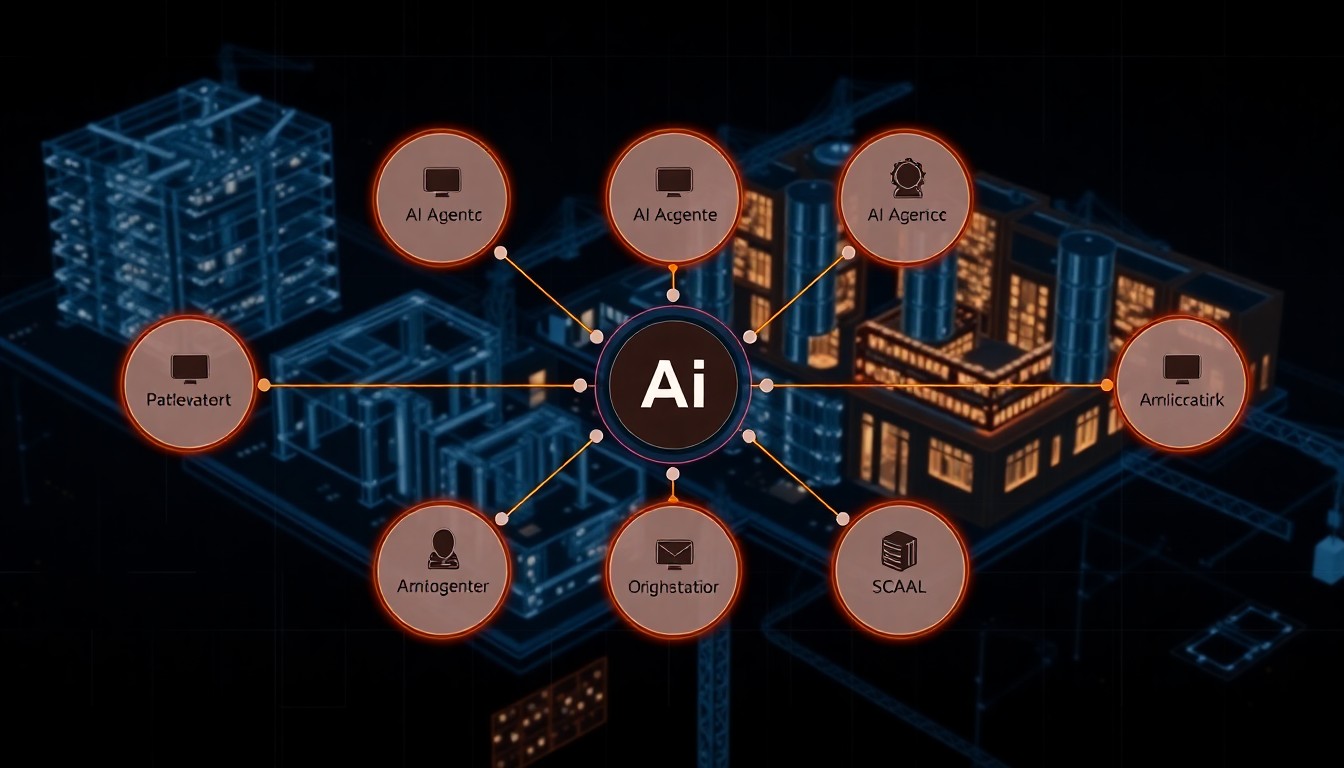
REDM (Real Estate Development Management) runs a hub-and-spoke multi-agent system. At the centre is the Planner — the sole orchestrator that receives every user request, decomposes it into tasks, delegates each task to the right specialist agent, validates the outputs, and synthesises the final result.
Six specialist agents handle distinct domains. The GIS agent queries spatial data — parcel boundaries, zoning, flood zones, soil classifications — from PostGIS and shapefile stores. The Finance agent runs feasibility models, cost benchmarking, and ROI projections from documented rate tables and market data. The Docs agent generates structured documents — site reports, design briefs, contracts, payment certificates — with full source citation. The ERP agent integrates with ERPNext for lead management, supplier records, procurement, and invoicing. The QS agent produces bills of quantities with rate analysis traced to the Kenyan costbook. The Security agent acts as the terminal auditor — every pipeline output passes through schema validation, rules compliance checking, and source verification before it reaches the client.
Each agent has a specific scope, specific tools, and a specific output schema. No agent steps outside its lane. No agent communicates directly with another agent — all coordination goes through the Planner. This is the same architecture that the AI industry is now independently converging on: specialised agents with defined boundaries, coordinated by an orchestrator that maintains the workflow state.
The difference is that REDM has been running this architecture in production since 2025, handling real development projects with real parcels, real cost data, and real regulatory constraints.
What multi-agent AI means for a developer commissioning a project
For a developer, the multi-agent architecture translates into a specific experience: you describe your project once — the parcel, the intended use, the target market — and the system produces a coherent set of outputs across every discipline.
A site report that combines the GIS agent's parcel boundary and zoning data with the Finance agent's preliminary cost benchmark and the Docs agent's structured report format. A feasibility study that layers the Finance agent's cost model over the GIS agent's buildable envelope analysis. A design brief that the Docs agent generates from the Planner's synthesis of the client's requirements and the site constraints. A bill of quantities that the QS agent produces from the same cost database that the Finance agent used for the feasibility estimate.
The outputs are consistent because they draw from shared source data — the parcel record, the costbook, the service catalog, the regulatory framework — rather than from separate manual workstreams that inevitably drift apart. When the feasibility estimate says KES 120 million, the subsequent bill of quantities starts from that same baseline.
This is what the AI industry means by agentic workflow: not a chatbot that answers one question, but a system that maintains state across a multi-step professional process and produces linked, consistent outputs at each stage.
The alternative: a single AI model trying to do everything
The current market is full of construction and real estate tools marketing AI features. Most are built on a single-model architecture: a large language model behind a chat interface, augmented with retrieval-augmented generation from a document store. They can answer a question about a contract clause, summarise a specification, or draft a simple document.
But they cannot manage a development lifecycle. Ask a single-model AI to check a parcel's zoning, run a feasibility model, generate a design brief, produce a bill of quantities, and push a supplier record to ERP — and it will fail. It will hallucinate costs it has not verified. It will cite zoning regulations that may not apply. It will produce a bill of quantities that does not reconcile with the cost estimate. It will do all of this confidently.
This is the core insight the AI industry is now acknowledging: complex professional work requires governance. Each agent's output must be validated against defined rules before it passes to the next stage. The orchestrator must be able to reject an output and re-route the task. The final output must carry a verifiable audit trail of which agent produced what and which data sources were used.
REDM's Security agent enforces exactly this governance. Every pipeline output is checked against non-negotiable system rules: no hallucinated parcel ownership, GIS results must cite data sources, ERP record IDs must come from actual API responses, finance outputs must include documented assumptions. Outputs with confidence below 0.6 are automatically blocked and sent back for revision.
The converging signals from AI research and construction practice
In July 2026, the AI research community and the AEC industry are converging on the same architecture from opposite directions.
From the AI side: MANTA proposes agents that reorganise dynamically. DeepSeek V4 Flash optimises for multi-step tool use. Claude Opus 5 benchmarks on long-horizon knowledge work. Every frontier lab is building what REDM already runs.
From the AEC side: at NXT BLD 2026 in London, the conversation was dominated by what Campbell Yule called 'the judgment stack' — AEC firms building their own AI layers above BIM tools rather than waiting for Autodesk or Revit to ship AI features. ALPA released an open-source 'Skills for Architects' repository — modular, executable architectural knowledge. Henderson Engineers and Buro Happold are building proprietary AI governance systems.
The industry is independently arriving at the architecture REDM implemented: modular expertise, structured governance, human-in-the-loop verification. The question for developers is not whether this architecture will become standard — the research and investment direction makes that clear. The question is whether to adopt it now, while the efficiency advantage over manual workflows is largest, or to wait until it is table stakes.
What a developer should ask of any AI-enabled development platform
If you are a developer evaluating technology for your next project, there are specific questions that separate a genuine multi-agent development platform from a single-model chatbot with a real estate wrapper.
First: can the system produce a site report that cites actual GIS data layers, not just a language model's recollection of what zoning categories exist? Does it show you the parcel boundary on a map, the zoning classification from the county GIS layer, the flood risk from the national dataset, and the buildable envelope calculation?
Second: can the system produce a feasibility model where every cost assumption is documented and traceable to a rate source? Does the bill of quantities reconcile with the feasibility estimate because they both draw from the same costbook?
Third: does the system have a governance layer — an explicit validation step that checks outputs against rules before they reach you? Can it tell you the confidence level of each output? Does it flag items that need professional review rather than silently passing them through?
These are the questions that distinguish a development operating system from a demonstration. REDM answers them because the architecture enforces them — not as a feature, but as a structural requirement of how the agents work together.
Next step
Turn this insight into a project decision
Use the free check or calculator while the question is still fresh. If the numbers make sense, continue into report delivery, capture and project setup.
Run a free project checkFrequently asked questions
What is a multi-agent AI system in simple terms?
A multi-agent AI system uses multiple specialised AI models rather than one general model. Each agent handles a specific domain — GIS analysis, cost estimation, document generation — and an orchestrator coordinates them. This is the architecture behind REDM's development management platform, and it is the same direction the major AI labs are now pursuing.
How is REDM different from a construction chatbot or AI assistant?
A chatbot answers one question at a time from a single language model. REDM coordinates six specialised agents to manage a full development lifecycle — from parcel search through feasibility, design, procurement, and handover. Each agent's output is validated before passing to the next stage, with an audit trail of which data sources were used.
Does using AI in real estate development remove the need for professional consultants?
No. REDM's agents automate data-intensive tasks — GIS queries, cost benchmarking, document assembly, compliance checking — but professional judgment on design, market conditions, contract risk, and site inspection remains with the registered consultants. The system supports consultants, it does not replace them.
What projects in Kenya is REDM currently managing?
REDM has been used on coastal development projects in Mombasa, including feasibility studies, cost plans, design briefs, and procurement documentation. The platform is designed for projects ranging from single-building developments to multi-parcel portfolio management.