Big Tech is spending billions on AI infrastructure — the real estate opportunity most developers are missing
Meta's free cash flow dropped from $8.5 billion to $784 million in a single quarter as AI infrastructure spending hit $31 billion per quarter. A UN report warns data centres will consume 945 terawatt-hours of electricity by 2030. Every server rack, every cooling plant, every substation needs land, zoning, design, construction, and commissioning — the full real estate development lifecycle. While the world watches the AI arms race, a parallel opportunity is forming in data centre real estate development, including in Africa. This article maps what that means for developers who understand both construction and technology.
The numbers that should make every developer sit up
In the second quarter of 2026, Meta reported financials that stunned the market. Free cash flow collapsed from $8.5 billion to $784 million — not because revenue fell, but because AI infrastructure spending reached $31 billion per quarter. Across the industry, Big Tech's combined AI capital expenditure for 2026 is projected to exceed $300 billion.
At the same time, a United Nations University report warned that data centres will consume 945 terawatt-hours of electricity and 9.3 trillion litres of water by 2030. That is roughly the electricity consumption of Japan — dedicated entirely to running server racks.
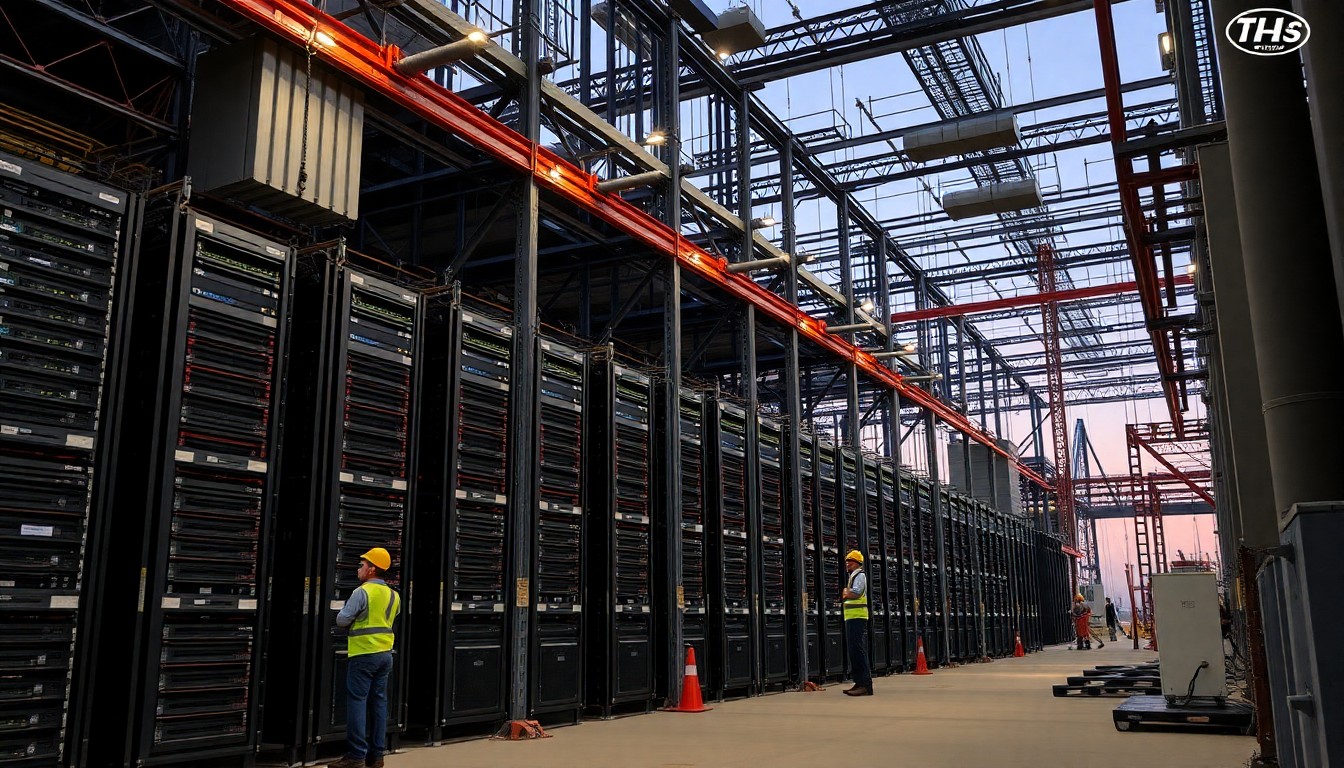
For the construction and real estate industry, these numbers represent something specific: an unprecedented build-out of physical infrastructure. Every data centre requires land acquisition, site selection against environmental and infrastructure criteria, zoning and permitting, design of specialised buildings with precise power and cooling requirements, construction management with demanding programme constraints, and commissioning and handover to the operator.
This is not a technology story. It is a real estate development story playing out at a scale the industry has not seen since the post-war infrastructure boom. And it is not limited to North America and Europe. Africa is in the path of this build-out.
Why Africa — and why Kenya — in the data centre development map
Data centre site selection follows a logic that favours specific African locations. The criteria are power availability and cost, fibre connectivity to submarine cable landing stations, political and regulatory stability, climate for cooling efficiency, and land availability at scale.
Kenya sits on four submarine cables — SEACOM, TEAMS, EASSy, and LION2 — providing direct fibre connectivity to Asia, the Middle East, and Europe. Mombasa is the landing point for three of them. Nairobi has emerged as a regional data centre hub, with facilities from Africa Data Centres, IXAfrica, and others either operational or under construction.
The Kenyan government's digital economy agenda, combined with relatively stable power supply from geothermal and hydro sources, positions the country as a credible location for the next wave of data centre investment. The developer who understands the site selection criteria — proximity to fibre nodes, power substation capacity, flood zone exclusion, land cost per acre at scale — can position land for data centre use before the operators arrive.
This is the same site evaluation discipline that REDM applies to any development project: parcel identification, zoning verification, constraint analysis, infrastructure assessment, and feasibility modelling. The land for a data centre is evaluated with the same tools as land for a residential development — only the criteria change.
What makes a data centre construction project different from a typical commercial build
Data centre construction introduces requirements that most developers and contractors in Kenya have not encountered. The building is not the product — the power and cooling are.
A typical data centre's construction cost is dominated by MEP systems, not structure and finishes. Power redundancy — N+1 or 2N configurations — drives electrical infrastructure cost to a multiple of what a commercial office building would require. Cooling — whether air-cooled, chilled water, or direct liquid — is a design discipline that most local MEP consultants do not routinely handle. Fire suppression must protect equipment without water damage — gas-based or mist systems rather than sprinklers. Physical security involves multiple perimeters, biometric access, and surveillance that exceed commercial standards.
The construction programme is also unusual. Data centre operators prioritise speed to market — a six-month delay in commissioning a facility that costs $200 million represents millions in lost revenue. The construction contract structures, procurement strategies, and payment mechanisms differ from standard building contracts.
For contractors and consultants, data centre work represents a premium market — higher specification, higher fees, higher barriers to entry. The firms that build the first facilities in the market establish the reference credentials that the next wave of operators will require.
The sustainability tension — and the construction opportunity it creates
The UN report on data centre resource consumption creates a tension that developers need to understand. On one side, the AI arms race demands more compute capacity, which demands more data centres. On the other side, the environmental impact of 945 TWh of electricity and 9.3 trillion litres of water is politically and regulatorily unsustainable.
That tension creates demand for sustainable data centre design: renewable power purchase agreements, on-site solar or wind generation, water-free cooling technologies, heat recovery systems that feed district heating networks, and low-carbon construction materials. These are not optional features — they are becoming procurement requirements for major operators under ESG commitments.
For developers and contractors, sustainable data centre construction is a differentiated offering. A developer who can present a site with a pre-negotiated renewable power agreement and a water-free cooling design has a proposal that a developer who can only present land does not. The value shifts from the land to what the land enables.
What a developer should do now to position for this opportunity
The data centre development opportunity in Africa is not theoretical — it is already visible in the project pipeline of the major operators. The developer who positions now will be the developer who has sites pre-evaluated against data centre criteria when the operators issue their next site selection RFI.
The first step is to understand the site criteria: proximity to fibre nodes, power substation capacity and redundancy, flood zone classification, land area and configuration, zoning that accommodates industrial or specialised use, and proximity to a skilled workforce.
The second step is to assemble the feasibility analysis: a site report that covers the constraint layers, a cost model that reflects the MEP-dominated cost structure, and a regulatory pathway that maps the permitting requirements for a facility of this type and scale.
REDM's project check provides the baseline for that analysis: the parcel boundary and zoning, the constraint layers, the preliminary cost benchmark for the building type, and the infrastructure proximity analysis. It is the developer's starting point for a conversation with a data centre operator — a documented, structured proposal rather than a verbal pitch.
Next step
Turn this insight into a project decision
Use the free check or calculator while the question is still fresh. If the numbers make sense, continue into report delivery, capture and project setup.
Run a feasibility checkFrequently asked questions
Is there demand for data centres in Kenya specifically?
Yes. Kenya is a recognised African data centre hub, with Nairobi hosting facilities from international operators and continued investment announcements. The combination of submarine cable connectivity, growing digital economy, and government digitalisation agenda makes Kenya a credible market for continued data centre investment.
What makes a site suitable for a data centre development?
Key criteria include proximity to fibre connectivity nodes, adequate and redundant power supply, flood zone exclusion, sufficient land area for phased expansion, zoning that permits industrial or specialised use, and distance from hazards such as fuel storage or flight paths. REDM's site analysis covers the spatial and regulatory layers relevant to these criteria.
How is data centre construction different from building a commercial office?
Data centres are MEP-dominated — power, cooling, fire suppression, and security systems account for a much higher share of construction cost than in commercial buildings. The specifications are more demanding, the programme constraints are tighter, and the contract structures differ. Experience in commercial construction does not automatically qualify a contractor for data centre work.
What is the scale of the data centre construction opportunity in Africa?
Africa currently accounts for approximately 2% of global data centre capacity but has the fastest-growing digital population. The investment gap — the capacity needed to serve projected demand — represents a multi-billion-dollar construction pipeline over the next decade. Kenya, South Africa, Nigeria, and Egypt are the primary markets.